The Supplement Nobody Is Being Honest About
Metabolism gummies are among the fastest-growing supplement products on the market. They are on the shelves of every major pharmacy, every big-box retailer, and every wellness-adjacent online store. They come in appealing flavors, attractive packaging, and price points that feel reasonable for something that promises to accelerate your metabolism, support fat burning, and boost your energy.
Nobody selling them will give you a complete honest account of what they actually contain, what those ingredients actually do at the doses included, and what a realistic expectation looks like for a real person taking them as directed.
This article does that. Not to dismiss the entire category — some of what is in these products has genuine metabolic relevance. But to close the gap between what the label implies and what the research supports, so that the decision to buy or not buy is made on accurate information rather than confident marketing.
That gap is wider than most people realize. And it matters before money changes hands.
Why Gummies Are a Challenging Format for Metabolism Supplements
Before examining the ingredients, it is worth understanding a structural limitation of the gummy format that shapes everything else about this category.
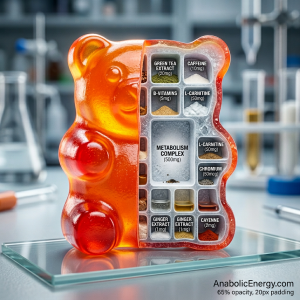
A standard two-gummy serving has significant volume constraints. Gummies must contain gelling agents, sweeteners, flavoring, coloring, and binding compounds alongside the active ingredients — leaving limited space for the compounds that are supposed to produce metabolic effects. This forces a choice: fewer active ingredients at meaningful doses, or more ingredients at doses too small to produce the effects research associates with them.
Most metabolism gummies choose the latter. The ingredient list is long and impressive. The doses are small and insufficient. This is not deception in the legal sense — the ingredients are genuinely present. It is the presentation of an ingredient list as evidence of efficacy when dose is what determines efficacy, not presence.
Comparing metabolism gummies requires comparing doses, not ingredient lists. Two products with identical ingredient lists but different doses are not equivalent. One of them may deliver meaningful metabolic support. The other may deliver the appearance of it.
The Ingredients and What the Research Actually Shows
B Vitamins appear in virtually every metabolism gummy formula — typically B1, B2, B3, B5, B6, B7, and B12. The rationale is metabolically sound: B vitamins are essential co-enzymes in glycolysis, the Krebs cycle, and the electron transport chain — the three pathways that produce ATP from food. Without them, metabolic energy production is impaired.
The gap between rationale and expected outcome is critical. B vitamins support metabolism in individuals who are deficient. In non-deficient individuals — which most adults consuming varied diets in developed countries are — additional B vitamins are excreted rather than used to accelerate energy production. The supplement does not create a new metabolic capability. It prevents a deficiency from impairing the existing one. For someone with B12 deficiency — vegan, older adult, individual with malabsorption — the energy improvement from correction can be significant. For someone already replete, the effect is marginal. The product cannot tell you which you are. Only a blood test can.
Green Tea Extract (EGCG) is the ingredient in metabolism gummies with the most direct thermogenic mechanism. EGCG inhibits the breakdown of catecholamines — particularly norepinephrine — sustaining the fat oxidation signal they produce. Research showing meaningful thermogenic effects uses doses of approximately 270 to 400 milligrams of EGCG. Most metabolism gummies contain 50 to 100 milligrams. The effect at sub-threshold doses is real but proportionally smaller — a fraction of what the research headline implies. If a product does not disclose its EGCG dose specifically, the dose is almost certainly below the research threshold.
Chromium enhances insulin signaling at the cellular level, supporting glucose uptake and blood sugar regulation. At research-relevant doses of 400 to 1,000 micrograms of chromium picolinate — the most bioavailable form — modest improvements in insulin sensitivity have been documented in individuals with existing insulin resistance. Consumer supplement doses are typically 35 to 200 micrograms — below the threshold used in research. The form matters too: chromium chloride and chromium nicotinate are less bioavailable than chromium picolinate. The form and dose together determine whether there is a meaningful effect or a label claim without proportional physiological consequence.
Apple Cider Vinegar appears in dehydrated form in many metabolism gummy formulas — including some of the most heavily marketed products in the category. The mechanism most frequently cited is acetic acid’s effect on post-meal blood glucose — slowing gastric emptying and reducing glucose absorption rate, producing a smaller post-meal insulin response. The effect on metabolic rate directly is negligible. The effect on blood glucose is real but modest — and occurs specifically around meals when ACV is consumed before or during eating, not from a daily gummy taken at an unspecified time. The dehydrated form delivers significantly less acetic acid than the liquid form used in research. ACV in gummies is more marketing than mechanism.
Iodine is required for thyroid hormone synthesis — and thyroid hormone is the primary hormonal regulator of metabolic rate. Iodine deficiency produces hypothyroidism and the metabolic slowing that accompanies it. Supplemental iodine in deficient individuals restores thyroid function and metabolic rate. In iodine-sufficient individuals — which most people with access to iodized salt are — additional iodine does not increase thyroid hormone production. Excess iodine can paradoxically impair thyroid function in susceptible individuals. As with B vitamins, the ingredient is metabolically relevant. Its benefit is conditional on deficiency being present.
Botanical Extracts — cayenne, ginger, black pepper (BioPerine), bitter orange — round out most metabolism gummy formulas. Cayenne contains capsaicin, which produces a transient thermogenic effect and a small increase in fat oxidation. The effect is real, modest, and attenuates with regular exposure. Ginger has mild thermogenic properties through its gingerol content. BioPerine enhances bioavailability of other ingredients — a legitimate formulation consideration. Bitter orange contains synephrine, a stimulant with modest thermogenic effects and some cardiovascular considerations at higher doses.
The Honest Tally
A well-formulated metabolism gummy from a transparent brand — one that discloses individual ingredient doses rather than hiding them in proprietary blends — might deliver: insurance against B vitamin and iodine deficiency where present, a modest thermogenic contribution from EGCG if the dose approaches research thresholds, marginal blood glucose stability support from chromium in bioavailable form, and small transient thermogenic effects from botanical compounds. According to the National Institutes of Health Office of Dietary Supplements, the evidence for dietary supplements marketed for metabolic support shows modest effects at best under research conditions — effects that are smaller in real-world use where diet, activity, and compliance vary.
A poorly formulated metabolism gummy — proprietary blend, undisclosed doses, low-bioavailability ingredient forms — delivers the appearance of the above without the substance.
Neither delivers the metabolic transformation the category implies. The interventions with the largest effect on metabolic rate — building lean muscle through resistance training, increasing dietary protein, improving sleep quality, managing chronic stress — are not in any gummy. They never will be. The gummy is marginal support for a foundation. It is not a substitute for one.
How to Evaluate Any Metabolism Gummy Before Buying
Demand Dose Transparency
If a metabolism gummy lists ingredients without listing the amount of each ingredient — or buries them in a “proprietary blend” with a total weight but no individual disclosure — the brand is preventing you from evaluating whether the doses are sufficient to produce the effects implied. This is a red flag, not a minor label quirk. Adequate doses of effective ingredients are a selling point. Brands that hide doses are typically hiding insufficient ones.
Compare the EGCG Dose to the Research Threshold
EGCG at 270 to 400 milligrams produces documented thermogenic effects. Find the EGCG or green tea extract dose on the label — not the total green tea extract standardized to X percent EGCG without specifying the milligram amount of EGCG. If the label does not allow you to calculate the actual EGCG dose, assume it is below threshold. Most are.
Verify the Chromium Form
Chromium picolinate is the most bioavailable and most researched form. Chromium chloride and chromium nicotinate are less bioavailable. The form is disclosed on labels that are being transparent about formulation quality. If only “chromium” is listed without the form specified, bioavailability is unknown.
Apply the Supplement Reality Test
Before purchasing any metabolism supplement, answer these questions: Is training consistent? Is protein intake at 0.7 to 1 gram per pound of bodyweight? Is sleep averaging seven to nine hours? Is chronic stress actively managed? If any of these answers is no, addressing them will produce larger metabolic effects than any gummy at any dose. If all answers are yes, a well-formulated gummy adds at the margin of a functional foundation — and may be worth its cost in that context.
Frequently Asked Questions
Do metabolism gummies actually work?
Some of their ingredients have genuine metabolic effects at appropriate doses. Most products underdose those ingredients relative to research thresholds. The realistic expectation for a well-formulated metabolism gummy is modest thermogenic support, micronutrient deficiency insurance, and marginal blood glucose stability improvement. Visible body composition changes from metabolism gummies alone — without supporting lifestyle changes — are not supported by the evidence in any product at any price point.
Are metabolism gummies safe?
Most are safe for healthy adults when used as directed. Products containing stimulants — bitter orange, caffeine — warrant caution from individuals with cardiovascular sensitivity or those consuming other stimulant sources. Green tea extract at very high doses has been associated with rare liver toxicity — relevant primarily for extremely high-dose products. B vitamins and trace minerals at supplement doses are generally well-tolerated. Read ingredient lists for stimulant compounds if you are sensitive to them.
Why do gummies have smaller doses than capsules?
Because gummies require significantly more space for their structural components — gelling agents, sweeteners, flavors, stabilizers — than capsules, which are almost entirely active ingredient and filler. A two-gummy serving may deliver 3 to 5 grams of total product, of which a relatively small proportion can be active ingredient. A two-capsule serving of equivalent size can deliver significantly more active ingredient because less space is required for the delivery vehicle. This is a formulation constraint, not a brand choice — and it is why capsule versions of the same formula typically deliver higher active ingredient doses.