Hard Is Not the Same as Effective
The most common mistake in metabolic conditioning is the belief that harder is better. That the amount of suffering produced by a session is proportional to the adaptation it creates. That the right way to judge a workout is by how completely it destroys you.
This belief produces people who work extremely hard at producing fatigue. It does not produce people who have developed their energy systems — because fatigue and energy system development are not the same thing, and confusing them is the reason most people who train hard for years still have the same metabolic ceiling they started with.
Metabolic conditioning is a training approach with a specific purpose: developing the body’s capacity to produce energy across multiple systems simultaneously, and to recover between high-intensity efforts fast enough to repeat them. Done correctly, it is the most time-efficient training modality available for improving body composition, work capacity, and cardiovascular health at the same time. Done incorrectly — which is how most people encounter it — it is accumulated fatigue that produces soreness without the specific adaptations it was designed to create.
The difference between those two versions is not effort. It is understanding what the effort is supposed to accomplish — and structuring it accordingly.
The Three Systems MetCon Is Actually Conditioning
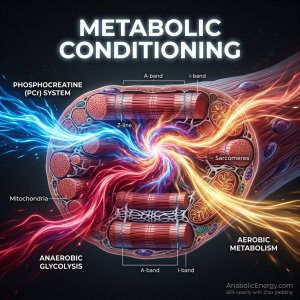
Metabolic conditioning develops three energy systems simultaneously by stressing each one within a single session through the deliberate manipulation of intensity, duration, and rest. Understanding what each system does — and what specific training variables stress it — is the foundation of effective MetCon programming.
The Phosphocreatine System powers maximal efforts of up to 10 seconds. It is the fastest, most powerful system — depleting rapidly and requiring full rest to restore. It develops through true maximal intensity work with complete recovery between efforts. It is stressed during MetCon when work intervals are short, intensity is genuinely maximal, and rest allows meaningful restoration before the next interval.
Anaerobic Glycolysis sustains high-intensity efforts from roughly 10 seconds to 2 minutes. It produces lactate and hydrogen ions that accumulate and eventually force deceleration. It develops through repeated exposure to efforts that produce significant lactate accumulation — training the muscle’s buffering capacity, improving glycolytic enzyme activity, and expanding the anaerobic energy pool. It is stressed during MetCon when work intervals are long enough to accumulate lactate but rest is insufficient for full clearance.
Aerobic Metabolism dominates efforts beyond 2 minutes and serves as the recovery infrastructure between anaerobic work intervals. In MetCon, aerobic metabolism is not trained by the work intervals — it is trained by what happens between them. The speed and efficiency with which the aerobic system can restore phosphocreatine, clear lactate, and reduce heart rate between intervals is what improves with MetCon training. This is the adaptation that most people never achieve because they either rest too long — removing the aerobic recovery stress — or do not work hard enough during intervals to produce the recovery demand that stresses the aerobic system meaningfully.
The interaction between these three systems during a MetCon session is what produces adaptations that neither pure strength training nor pure cardio creates. The body is simultaneously being forced to produce maximum effort and recover from it — a demand that develops the capacity to transition between energy systems efficiently, which is what real-world physical performance requires.
The Variable Nobody Talks About: Rest
In most fitness conversations, the work interval gets all the attention. How hard, how long, what movement. The rest interval is treated as a necessary pause between the parts that matter.
In metabolic conditioning, the rest interval is half the training stimulus. It determines which energy systems are stressed, what kind of fatigue accumulates across the session, and whether the protocol produces the adaptations it is designed to produce or simply generates undifferentiated exhaustion.
Short rest — insufficient for meaningful recovery — forces the aerobic system to work hard between intervals, building aerobic recovery capacity at the cost of work interval quality. The intensity of each subsequent interval is lower than the one before because the anaerobic systems have not restored. This is appropriate for developing aerobic work capacity and lactate tolerance. It is not appropriate for developing peak anaerobic power.
Long rest — approaching full recovery — allows high quality in each work interval, preserving the intensity needed to stress the phosphocreatine system and produce meaningful lactate accumulation. The aerobic recovery stress between intervals is lower. This is appropriate for developing peak anaerobic capacity and maximum power output. It is not appropriate for developing the aerobic recovery infrastructure.
Most MetCon protocols use intermediate rest ratios — 1:2 to 1:3 — that stress both the anaerobic systems during work and the aerobic system during recovery without fully optimizing either. This is the deliberate trade-off of metabolic conditioning: developing multiple systems simultaneously rather than maximizing the development of any one. The value is breadth of adaptation. The cost is that no single system is developed as rapidly as it would be through dedicated, system-specific training.
The Two Errors That Turn MetCon Into Suffering Without Adaptation
Two mistakes dominate most people’s experience with metabolic conditioning — and both produce the same outcome: exhaustion without the specific energy system adaptations MetCon is designed to create.
The intensity error. Treating every session as a maximum effort event, measuring the session’s success by how completely it depletes the participant. This approach consistently produces central nervous system fatigue, accumulated inflammation, degraded work quality across intervals, and a recovery demand that exceeds what the body can restore before the next session. The adaptations of metabolic conditioning — improved buffering capacity, expanded anaerobic glycolytic capacity, faster aerobic recovery — require quality work at sufficient intensity. They do not require and are not improved by routinely training to complete inability to continue.
The cardio error. Performing circuit training or interval work at intensities that never genuinely challenge the anaerobic systems — calling it MetCon because it involves multiple movements and elevated heart rate. Without sufficient intensity during work intervals to produce meaningful lactate accumulation, the session develops aerobic fitness and muscular endurance without developing the anaerobic capacity that metabolic conditioning specifically targets. The session produces fatigue. It does not produce the ceiling-raising adaptations that genuine MetCon creates.
According to the National Strength and Conditioning Association, effective metabolic conditioning requires deliberate prescription of intensity, volume, and rest — not simply performing exercise to exhaustion or selecting movements that elevate heart rate. The prescription is what creates the specific adaptation. The effort without the prescription creates fatigue.
What Changes When You Program It Correctly
The body that has genuinely developed its metabolic conditioning capacity looks, performs, and recovers differently from the body that has accumulated years of high-effort but undifferentiated training.
Work capacity increases — more quality work can be performed per session and per week because anaerobic systems recover faster between efforts. Body composition improves — the combination of anabolic hormonal response, EPOC effect, and muscle mass development from compound movement MetCon produces simultaneous improvements in muscle and fat loss that moderate cardio produces more slowly. Cardiovascular efficiency improves — resting heart rate decreases, stroke volume increases, and VO2 max rises as the aerobic recovery infrastructure develops. Performance ceiling rises — the maximum intensity that can be sustained for a given duration increases as buffering capacity, glycolytic capacity, and aerobic recovery all improve together.
These adaptations develop over weeks and months of consistently programmed MetCon — not from a single brutal session or a month of random high-intensity circuits.
How to Program It
Define the Adaptation Before Selecting the Variables
Decide what the session is developing before choosing work interval duration, rest interval duration, or movements. A session targeting anaerobic glycolysis and buffering capacity uses 20 to 90 second work intervals at near-maximal intensity with 1:3 to 1:5 work-to-rest ratios. A session targeting aerobic recovery capacity uses longer work intervals at submaximal intensity with 1:1 to 2:1 work-to-rest ratios. A session targeting phosphocreatine capacity uses 6 to 10 second maximal efforts with full rest. Mixing these randomly produces mixed results — some development of each system but optimization of none.
Select Movements That Allow Intensity
The movements in a MetCon session should allow the intensity the protocol demands without breaking down technically under fatigue in ways that create injury risk. Compound movements involving large muscle mass — kettlebell swings, rowing, cycling, sled pushes, thrusters, carries — produce the greatest metabolic and hormonal response per unit of time. Technically complex movements under high fatigue — Olympic lifts at high rep schemes — introduce injury risk that reduces training longevity without proportionally increasing metabolic benefit.
Protect the Sessions That Need to Be Hard
Two to three genuine MetCon sessions per week is the ceiling for most people. The recovery demand of high-intensity anaerobic work — central nervous system fatigue, muscle damage, glycogen depletion — requires 48 to 72 hours before quality can be restored. More frequent sessions without adequate recovery degrade work quality below the intensity threshold required for adaptation. The sessions that need to be hard need to actually be hard — which requires that recovery between them is sufficient for that quality to be achievable.
Build the Aerobic Base First
The aerobic system is the recovery infrastructure MetCon runs on. An underdeveloped aerobic base means slow recovery between intervals, reduced quality of work across a session, and diminished adaptation from the same protocol. Four to eight weeks of foundational aerobic training — three to five sessions per week of sustained moderate effort — before introducing structured MetCon significantly improves the quality of metabolic conditioning and the adaptations it produces. You cannot fully develop the interaction between energy systems if one of them has not been developed enough to play its role.
Frequently Asked Questions
What is metabolic conditioning?
A training approach that develops multiple energy systems simultaneously — the phosphocreatine system, anaerobic glycolysis, and aerobic metabolism — by deliberately manipulating work interval duration, rest interval duration, and intensity within a single session. When programmed correctly, it improves aerobic capacity, anaerobic power, work capacity, and body composition more efficiently than training any single system in isolation. When programmed incorrectly, it produces fatigue without the specific adaptations it was designed to create.
What is the difference between MetCon and HIIT?
High-intensity interval training alternates high-intensity work with lower-intensity recovery — a broad category that includes many training approaches. Metabolic conditioning is a specific implementation designed to develop all three energy systems by stressing anaerobic systems during work intervals while simultaneously training the aerobic system’s capacity to recover between them. All MetCon involves intervals. Not all interval training develops the multi-system capacity that genuine MetCon targets.
How do I know if I am working hard enough during MetCon?
During anaerobic-focused work intervals, you should be producing genuine lactate accumulation — the burn should be real, breathing should be significantly elevated, and sustaining the effort beyond the prescribed interval should be genuinely difficult. During aerobic-focused work intervals, you should be working at a pace that challenges but does not exhaust within the interval. If every session feels identical regardless of the protocol, the intensity calibration needs adjustment. Different protocols should feel meaningfully different.
Is metabolic conditioning good for fat loss?
Yes — through three compounding mechanisms. The session itself burns significant calories through high muscle mass involvement and intensity. The EPOC effect elevates metabolic rate for hours after each session. The muscle mass maintained and developed through compound movement MetCon permanently raises basal metabolic rate. The combination makes well-programmed MetCon one of the most time-efficient training approaches for body composition improvement available.
How long should a MetCon session be?
Effective MetCon sessions are typically 20 to 40 minutes of actual work — not including warm-up and cool-down. Longer sessions at genuinely high intensity are not possible without degrading work quality below the threshold that produces meaningful adaptation. Sessions that extend to 60 or 90 minutes are either operating at intensities too low to qualify as genuine metabolic conditioning, or accumulating fatigue rather than adaptation. Shorter, higher quality sessions consistently outperform longer, lower quality ones for the specific adaptations MetCon is designed to produce.
Can beginners do metabolic conditioning?
Yes, with appropriate intensity calibration and movement selection. The error most beginners make is performing protocols designed for trained individuals without the aerobic base, movement competency, or recovery capacity to execute them at the required intensity. Building an aerobic base, mastering movement patterns at lower intensities, and beginning with conservative work-to-rest ratios before progressing produces better long-term MetCon development than immediately attempting advanced protocols at compromised quality.